What Port Antigua Islamorada Real Estate Really Buys
The portal median for Islamorada tells you a canal home costs seven figures. It does not tell you which seven-figure homes come with a mile of private beach, which ones let a tower boat leave the dock without waiting for a bridge, and which ones quietly cap the short-term rental math a buyer was counting on.
Port Antigua sits at the intersection of all three questions. It is a deed-restricted community of more than 300 waterfront properties near Mile Marker 75 on Lower Matecumbe Key, and the reasons it trades where it does have very little to do with square footage.
Before the beach, before the boat access, one line in the PAPOA materials reshapes the buyer pool. Rentals in Port Antigua carry a thirty-day minimum. Anything shorter requires a vacation rental license, which most homes in the community do not carry.
If a buyer's model assumed weekly high-season rentals to offset carry costs, that model needs to be rebuilt before the offer is written. Long-stay winter tenants at monthly rates are a different business than weekly turnover, with different revenue, different wear, and a different tax treatment. A single 3-bed canal home in the community was recently listed for winter tenancy at $8,000 per month plus 12.5% tax, which gives a workable ceiling for underwriting rather than the optimistic weekly-rate arithmetic buyers sometimes bring down from Miami.
Two Florida statutes tighten the transaction further. Under Fla. Stat. §720.401, sellers in a deed-restricted community must deliver a covenants disclosure summary at contract. Under §720.30851, the association's estoppel or resale certificate preparation fee is capped at $299. Buyers who have transacted in unrecorded communities in South Florida often expect neither document and neither charge. Both belong in the closing timeline.
The single most misread number in Keys canal shopping is the bridge clearance between a dock and open water. It is why identical-looking homes on identical-looking canals can price millions apart.
Port Antigua sits close to both Channel 2 and Channel 5. Larger vessels, including center consoles carrying towers and outriggers, can transit to the Atlantic without waiting on a lift span. That is a materially different daily experience from communities tethered to the Snake Creek bascule bridge, which offers roughly 27 feet of vertical clearance when closed and opens on signal under federal drawbridge rules. A captain who runs a 24-foot skiff will not feel the difference. A captain who runs a fully rigged 34-foot center console with a tuna tower will feel it every morning.
Access variable | Port Antigua (MM 74–75) | Snake Creek-dependent canals (MM 85–86) |
|---|---|---|
Route to open water | Channel 2 and Channel 5 bridges | Snake Creek bascule bridge |
Air-draft ceiling | Fixed spans, no lift | ~27 ft closed, opens on an hourly schedule |
Outboards and Sportfishers | Skiffs, family cruisers, tower boats | Sportfishers scheduled around openings |
Public Marinas | Private, PAPOA members and guests | Varies; often public marina backup |
The bayside orientation adds a second, quieter advantage. Wide canals feed into the protected water of Florida Bay, and PAPOA's own rules require watercraft to operate at idle speed with no wake throughout the canals, including the first 100 yards at the main entrance. Owners swim in these canals, and the community writes rules that treat them like a shared amenity rather than a highway.
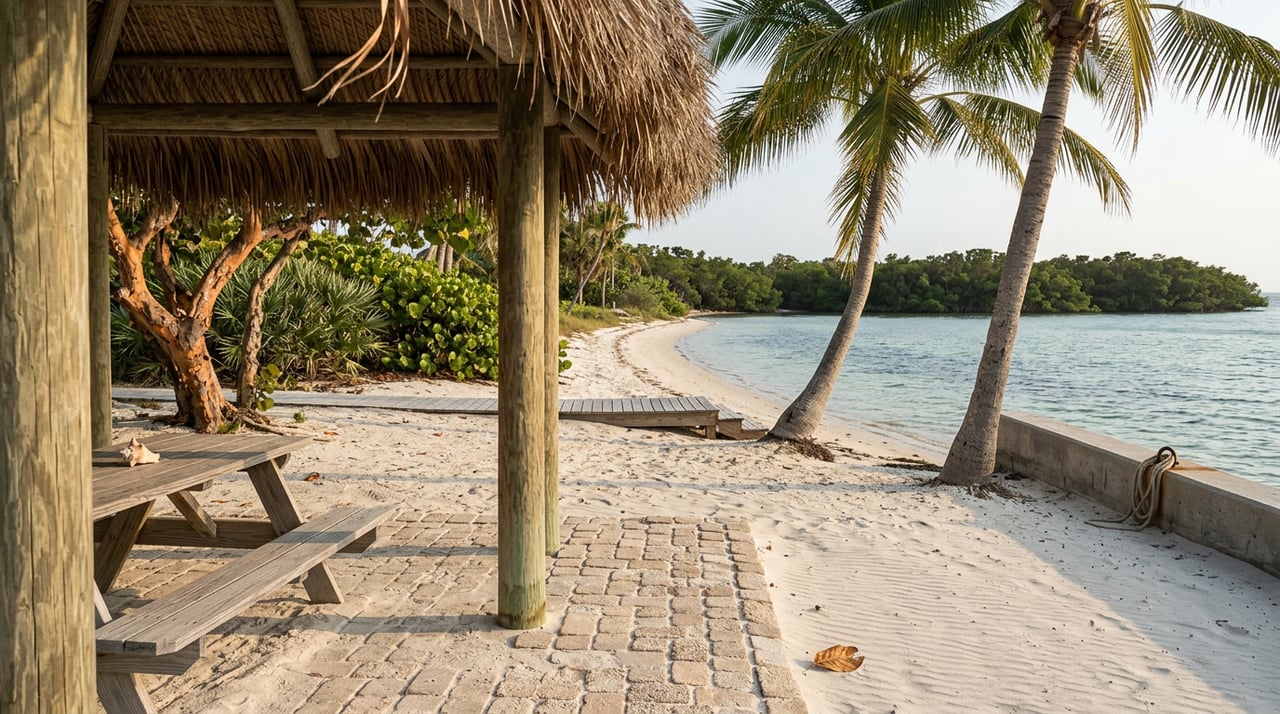
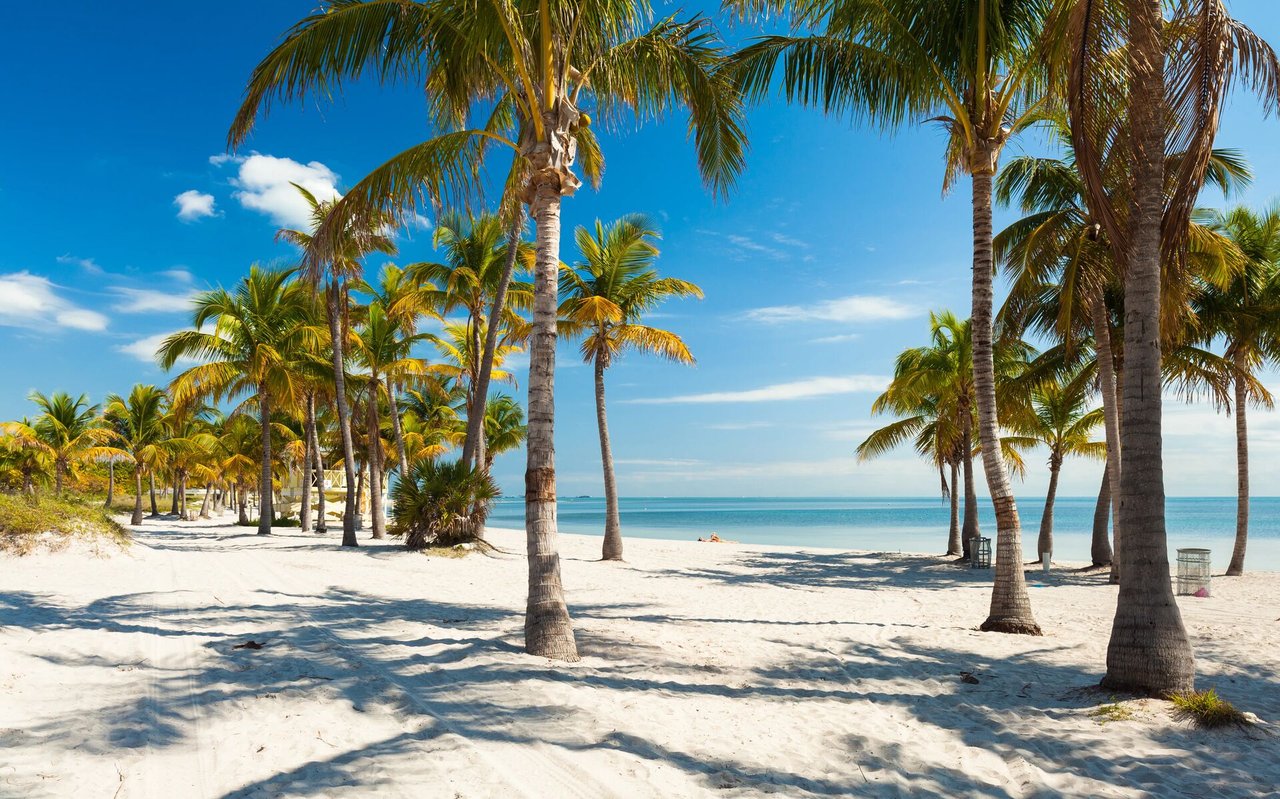
MLS photos of a canal-front elevation do not convey the neighborhood's most unusual amenity. Port Antigua's members share a bayside white-sand beach that runs roughly a mile, with tiki huts, picnic tables, grills, and a private boat ramp. Access is restricted to homeowners and their guests.
For context, most single-family owners in the Keys drive to public shorelines. Anne's Beach, a short distance south on Lower Matecumbe, is the closest public equivalent and is beloved for exactly that reason. When you buy in Port Antigua, you are buying a deed-attached alternative to that drive, and you are buying it in perpetuity because it sits in the community's common property rather than in a private title.
This is where the median obscures the price. Two canal homes with similar interiors, similar dockage, and similar year of build can look interchangeable on a portal. If one carries the PAPOA beach and ramp access and the other does not, the buyer pool for each home is different, and the exit strategy is different.
Deed restrictions are the reason the neighborhood looks the way it does, and they are also the reason certain plans need to be checked before an offer, not after. The PAPOA architectural committee reviews changes on top of the Village of Islamorada's building code, and in some categories it applies a stricter standard.
A buyer who plans to install a stealth trailer parking pad on a second lot, drop in a quick above-ground pool for the grandchildren, or add a nonconforming shed should treat those plans as contingencies to resolve, not as post-closing projects.
For sellers, and for buyers modeling their eventual exit, the useful comparison is not Islamorada against the U.S. It is Islamorada against Florida.
Florida Realtors' chief economist Dr. Brad O'Connor reported that in April 2026 the statewide median time from listing to contract for single-family homes was 44 days, and framed 2026 as an inflection between a 2019-style plateau and a 2025-style lengthening in time on market. The Keys, and Islamorada in particular, run materially slower at the top of the price stack. Time-on-market figures well above the state median are the normal condition of the luxury waterfront band, not a signal of a stalled listing.
The practical implication for a Port Antigua seller is that a marketing window measured in months rather than weeks is the base case, and pricing discipline in the first thirty days matters more than the drama of a headline reduction later. For a buyer, it means the same home is unlikely to draw the sort of same-week bidding pressure that defines urban Florida markets, and a considered inspection and closing timeline is defensible.
Set the amenity bundle beside the constraint bundle, and the pricing logic becomes readable.
On the amenity side sit the shared beach, the ramp, the wide bayside canals, the tower-friendly channel access, the reinforced aesthetics, and the enforced quiet on the water. On the constraint side sit the thirty-day rental minimum, the architectural committee, the golf cart geometry, the covenants disclosure requirement at contract, and the longer marketing runway typical of the price band. Two look-alike homes at MM 75 can carry different water depths at the dock, different distances to the ramp and beach, and different lot geometry inside the deed restrictions. Each of those differences shows up in the number a buyer should actually pay, and none of them are visible in a median.
Can I run a short-term vacation rental from a Port Antigua home? Not by default. PAPOA rules set a thirty-day minimum. A property already carrying a vacation rental license is the exception, and the license, not the address, is what makes shorter stays legal.
Does every Port Antigua property share the private beach and ramp? Access flows from PAPOA membership, which is tied to ownership within the community. Confirm current dues, common-area rights, and any pending assessments in writing before closing, and request the association's covenants disclosure summary as required under Fla. Stat. §720.401.
How is Port Antigua different from Venetian Shores for a boater? Different bridges, different owner profiles. Port Antigua clears to open water via Channel 2 and Channel 5 without a lift span, which suits tower boats and larger center consoles. Venetian Shores' fastest ocean route runs under the Snake Creek bascule bridge, which affects daily timing for taller vessels.
What should I ask for on inspection that a mainland buyer would not? Dock depth at mean low water at the specific slip, seawall condition and any tie-back rust bloom, permitted status of the existing dock and lift with the Village of Islamorada, and written confirmation of any deeded rights to community common areas.
Deciding what a Port Antigua home is worth to you is a boat question, a beach question, and a covenants question before it is a square-footage question. When you are ready to work through those questions on a specific property, Alina Davis knows this stretch of Lower Matecumbe well. Let's Connect.

Whether you're searching for your perfect Keys escape, investing in a vacation rental, or selling a slice of paradise you've loved for years, my goal is always the same: honest guidance, strong advocacy, and a seamless experience from start to finish. The Florida Keys isn't just real estate — it's a lifestyle, and I'm here to help you find your place in it. I would be honored to help you take that next step toward sun, water, and everything the Keys has to offer.